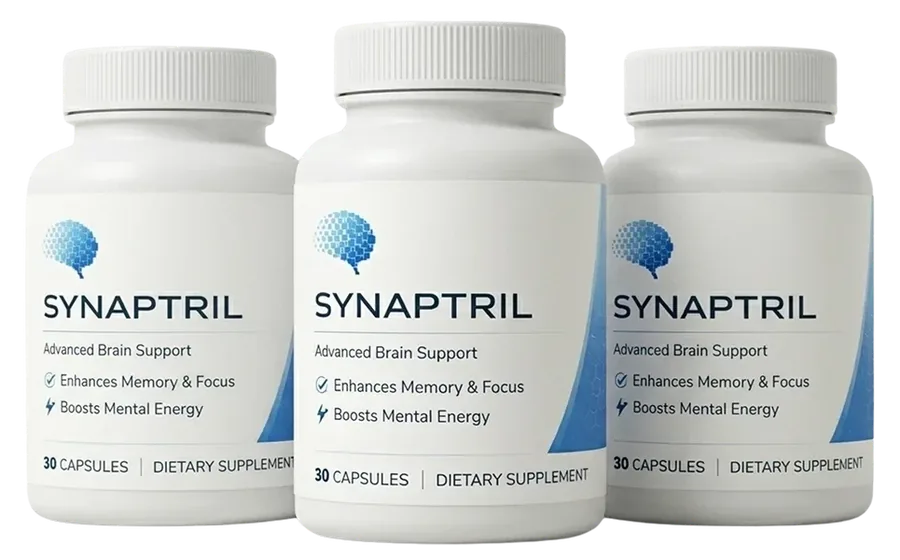
Ingredient 1 of 6
Magnesium Glycinate for Brain Support: What 80 mg in Synaptril Can and Cannot Do
Magnesium glycinate for brain support is a common sales idea, but the research is thin. In Synaptril, it is line 1 of the blend and supplies 80 mg of magnesium, 19% of the Daily Value. The NIH fact sheet covers no memory data, and a small sleep review found low-quality evidence for falling asleep about 17 minutes faster.
Written by the Synaptril label deskUpdated
The label line01
What is magnesium glycinate in Synaptril?
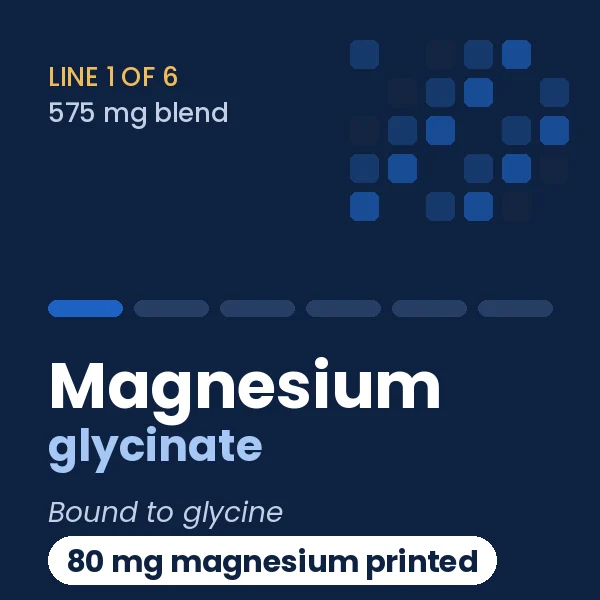
Magnesium glycinate is magnesium bound to glycine, a small amino acid. It is the first line of the Synaptril blend, so it weighs more than any other ingredient in the capsule.
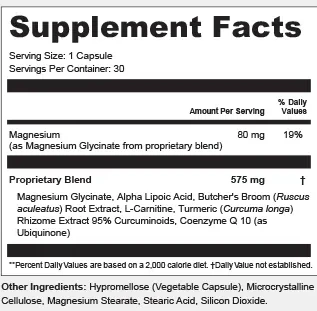
It is also the only line with a printed amount. The Supplement Facts panel reads: magnesium (as magnesium glycinate from proprietary blend) 80 mg, 19% DV. The other five lines show no amount at all.
Magnesium is an essential mineral used in hundreds of enzyme reactions. Most adults get it from nuts, beans, whole grains and leafy greens (NIH ODS, Magnesium).
Where it sits on the panel
The magnesium row sits above the blend because it is the one nutrient with a Daily Value. The full panel, typed out line by line, is on the Synaptril supplement facts page.
| Name on the label | Magnesium Glycinate (magnesium 80 mg, 19% DV) |
|---|---|
| What it is | Magnesium bound to the amino acid glycine |
| Place on the label | Line 1 of 6 in the 575 mg proprietary blend |
| Amount per capsule | 80 mg of magnesium (19% DV), printed; the glycinate compound likely weighs about 400-570 mg |
| Amount used in research | RDA 310-420 mg a day from all sources; supplement limit 350 mg |
| Strength of evidence | No memory trials found; a small sleep-onset effect in older adults |
| Marketed or traditional use | Essential mineral |
| Main caution | Loose stools at high intake; space it from some antibiotics and bisphosphonates; kidney disease needs a doctor's advice. |
Evidence02
Is magnesium glycinate for brain health backed by research?
No, not for memory or focus. We found no trial of magnesium glycinate, or of Synaptril, that measured memory, attention or thinking speed.
The NIH Office of Dietary Supplements keeps the main magnesium fact sheet. It covers bones, blood pressure, diabetes and migraine, and it does not cover cognition or dementia at all (NIH ODS, Magnesium).
Brain-health experts who reviewed supplements as a group could not endorse any ingredient for memory (GCBH/AARP 2019, brain supplements). A low magnesium level is a real problem, but a doctor finds it with a blood test, not with a capsule.
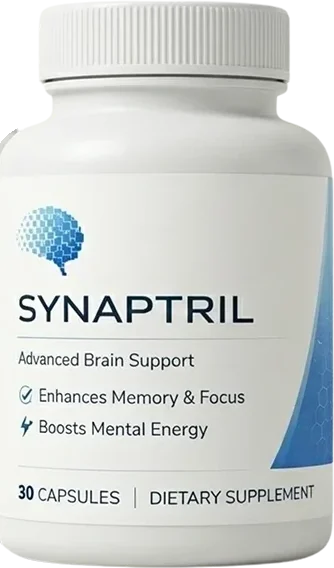
The front reads "Advanced Brain Support" and "Enhances Memory & Focus". Those are structure/function phrases with the FDA asterisk. They are not test results, and no study links 80 mg of magnesium to either one (21 CFR 101.93, structure/function claims).
Dose03
How does 80 mg of magnesium compare with the RDA?
80 mg of magnesium is about a fifth of the adult RDA. Men need 400-420 mg a day and women 310-320 mg, counting food, water and supplements together (NIH ODS, Magnesium).
For a man needing 420 mg, one capsule covers 19%. For a woman needing 310 mg, it covers about 26%. The rest still has to come from meals.
There is also a ceiling. Adults should keep magnesium from supplements and medicines under 350 mg a day, because more tends to cause diarrhea (NIH ODS, Magnesium). One capsule uses about 23% of that limit.
| Reference amount | Daily figure | Share from one capsule |
|---|---|---|
| RDA, men 31 and older | 420 mg | About 19% |
| RDA, men 19-30 | 400 mg | About 20% |
| RDA, women 31 and older | 320 mg | About 25% |
| RDA, women 19-30 | 310 mg | About 26% |
| Upper limit from supplements | 350 mg | About 23% |
Blend math04
How much of the 575 mg blend is magnesium glycinate?
Most of it, by our estimate. Magnesium glycinate is only about 14% magnesium by weight, because the glycine part is heavy. Buffered grades reach about 20%.
So 80 mg of magnesium likely needs about 400-570 mg of the compound. The label does not print this number. We worked it out from the formula weight.
Start with the printed 80 mg
The panel says the 80 mg of magnesium comes from the glycinate inside the 575 mg blend.
Divide by the magnesium share
80 mg divided by 0.14 is about 570 mg. At a 20% buffered grade, it is 400 mg.
Subtract from the blend
575 mg minus 400-570 mg leaves about 5-175 mg for the other five lines together. That is an estimate, not a lab result.
The math also limits the next line. Alpha-lipoic acid is likely under about 175 mg, and butcher's broom under about 88 mg. Every line is compared with research on the Synaptril ingredients page.
Forms05
Is magnesium glycinate better than magnesium oxide?
Magnesium glycinate is a different trade-off, not a proven upgrade. It is often chosen because many people find it gentle on the stomach, but it carries much less magnesium per milligram of powder.
Magnesium oxide is about 60% magnesium by weight, so 80 mg of magnesium fits in roughly 135 mg of oxide. The same 80 mg as glycinate fills most of the capsule.
Bulky, mild
About 14-20% magnesium. Bound to glycine. Widely sold as a gentle form. We found no memory study of this form.
Compact, common
About 60% magnesium. Cheap and small. Also linked to loose stools at high doses, like most forms.
Neither form has memory trials. The useful question is how much magnesium you already eat.
Synaptril: from $49 a bottle30 capsules · 2, 3 or 6 bottles · free shipping on 3 or 6 · 60-day money-back guarantee
See packsSleep06
Can magnesium glycinate help with sleep?
Maybe a little, and the evidence is weak. A 2021 review pooled 3 small trials with 151 older adults who had insomnia (Mah & Pitre 2021, magnesium and sleep).
People taking magnesium fell asleep about 17 minutes sooner than with placebo. Total sleep time did not change in a clear way. The authors rated the evidence low to very low quality.
Those trials were about sleep, not memory, and none used Synaptril. Steady habits matter more: the CDC advises adults to get 7 or more hours a night (CDC, About Sleep).
Safety07
Who should be careful with the magnesium in Synaptril?
People on certain antibiotics or bone drugs, and people with kidney disease, should check with a pharmacist or doctor first. At 80 mg, stomach upset is unlikely, but timing still matters.
Diuretics and long-term acid reflux medicines (PPIs) can lower magnesium levels, which is a reason to ask about testing (NIH ODS, Magnesium).
Take tetracycline or quinolone antibiotics at least 2 hours before or 4-6 hours after magnesium. Keep bisphosphonates for bone loss at least 2 hours apart. With kidney disease, ask a doctor first, because weak kidneys clear magnesium slowly (NIH ODS, Magnesium). Keep taking prescribed medicine.
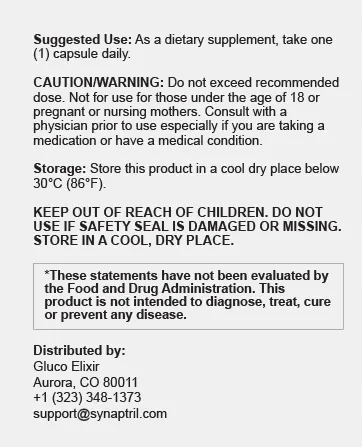
The label adds its own caution for anyone under 18, pregnant or nursing. More is on Synaptril side effects.
Next08
What should you weigh before relying on magnesium glycinate?
Weigh it as a modest mineral top-up. One capsule gives a fifth to a quarter of the RDA in a gentle form, and nothing more is proven.
Count your food and any other supplement first, and stay under 350 mg a day from pills. See how to take Synaptril for the routine.
FAQ09
Magnesium glycinate questions people search
Is 80 mg of magnesium a day enough?
It is enough to add a fifth to a quarter of the adult RDA, which is 310-420 mg a day from all sources. Most of your magnesium should still come from food such as beans, nuts and greens. A doctor can test you if you suspect a real shortfall (NIH ODS, Magnesium).
Can I take Synaptril with another magnesium supplement?
Add the two first. Adults should keep magnesium from supplements and medicines under 350 mg a day, because more often causes diarrhea and cramps. Synaptril gives 80 mg, so a second product with 270 mg or more would push you over that limit (NIH ODS, Magnesium).
Is magnesium glycinate better than magnesium oxide?
Not in any proven way for memory or focus. Glycinate is widely described as gentle on the stomach, but it holds only about 14-20% magnesium by weight. Oxide holds about 60%, so the same magnesium takes far less powder. Neither form has memory trials behind it.
Can I take Synaptril with doxycycline or ciprofloxacin?
Ask your pharmacist about timing first. Magnesium can bind tetracycline and quinolone antibiotics in the gut and weaken them. The NIH advises taking the antibiotic at least 2 hours before or 4-6 hours after magnesium (NIH ODS, Magnesium). Finish the antibiotic course as your doctor directed.
Is magnesium glycinate safe with kidney disease?
Talk to your kidney doctor before taking it. Healthy kidneys flush extra magnesium, but damaged kidneys clear it slowly, so levels can build up. The NIH notes that the risk of magnesium toxicity rises as kidney function falls (NIH ODS, Magnesium).
Will the magnesium in Synaptril help me sleep?
Nobody has tested that. A review of 3 small trials in 151 older adults with insomnia found sleep came about 17 minutes sooner with magnesium, but the evidence was rated low quality (Mah & Pitre 2021, magnesium and sleep). Those studies did not use Synaptril. Regular sleep hours remain the better-supported step.
Does magnesium glycinate cause diarrhea?
It can at high intakes, though 80 mg is low. Diarrhea, nausea and cramps are the usual signs of too much magnesium from pills, mostly above the 350 mg daily limit for supplements (NIH ODS, Magnesium). If loose stools start after you begin the capsules, stop them and tell your doctor.
Who wrote this10
Written and reviewed by
Pages built from the label, the sales page and linked NIH, FDA, CDC, FTC and peer-reviewed sources.
Last updated . Read our editorial standards and how we check reviews. This website is run by an American Synaptril authorized shop, not by the manufacturer or the distributor. We earn money when you buy through our order links.
Keep reading
More about Synaptril
American Synaptril authorized shop
Ready to try Synaptril?
Start with a medicine check, then choose your pack. Three or six bottles cost less per bottle and ship free, and each pack comes with the 60-day money-back guarantee.
- Secure checkout
- 60-day money-back guarantee
- Ships from the U.S.